Posts

Continuation of the T-80BVM saga

Image
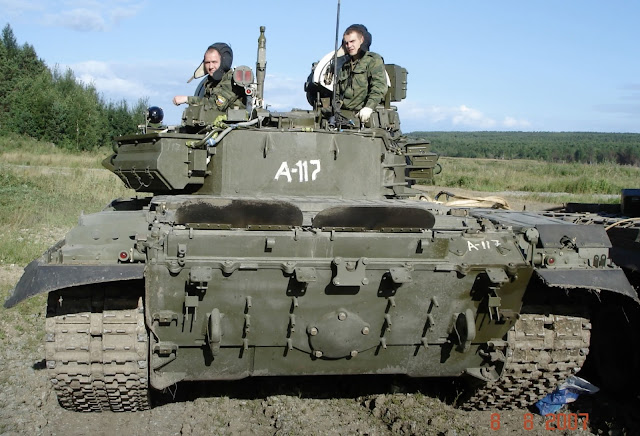
 Earlier this year I covered the implementation of a variety of new things on batches of newly made T-80BVM tanks. A new Combat Approved - "Военная Приёмка" episode dedicated towards the T-80BVM has provided further footage, which expands on some previously covered topics centred around the tank. This episode featured closeups of several improvements made to the T-80BVM. One of the more interesting showcases was the anti-drone/top-attack cage. As stated in an earlier blog post  ( Combat experience application to the newest batch of T-80BVM tanks ), the cage uses gabled protective plates, which are hollow. Also, the new cage uses 2 hinge mounted panels, which use a steel mesh material as a solution to stop threats from above.  Close-up view of the gabled plates  The gabled plate design is presumably made using steel sheets which are separated by a layer of air, which is intended to act as spaced armour to combat shaped charge munitions. In the aforementioned bl...
Autoloading system for 76mm automatic cannon on light AFV

Image
 In the early to mid-1980s, the Soviet Union attempted to develop a 76mm automatic cannon fitted to fire telescoped ammunition to reduce toxic fume accumulation inside AFV crew compartments. The system was made to follow the existing AFV design philosophy, which was the limited application of extra mass and limited internal volume displacement.  In comparison with conventional Soviet-designed artillery systems, this system possessed certain advantages. Higher RoF at 60 rounds/minute, improved vertical elevation angles of -5 to +50, automatic ammunition feeding mechanism with a 104-round ready rack, exclusion of adverse inertial effects of the automatic loading mechanism on firing accuracy, use of telescoped rounds reduced toxic fume accumulation compared to standard shell casing ejection, ability to quickly change ammunition types, compact mass and ease of use.  Along with the experimental cannon, an experimental automatic loading mechanism was created. This mechanism o...

Modernization and retrofit of discontinued tank variants

Image
From the end of the 1970s until the early 1980s, the Soviet Union created plans to modernize its ageing fleet of 2nd generation post-war tanks: the T-55, T-55A and T-62. The modernization programs would focus on tanks undergoing significant repairs, improving firepower, mobility, survivability and protection without significant changes to base vehicles. These vehicles would rival the Western bloc tanks such as the M48, M60, M60A1, Leopard 1 and the Chieftain Mk.2/Mk.3. Post-modernization, the T-55, T-55A and T-62 would be turned into T-55M, T-55AM and T-62M. The new modernized vehicles would rival more advanced upgrade versions of the previously mentioned Western bloc vehicles like the M60A3, Leopard 1A4 and Chieftain Mk.5. The following upgrade features were applied to T-55, T-55A and T-62 tanks.  Tank barrel thermal sleeves  More powerful munitions  Ability to utilize barrel-fired ATGMs to improve engagement ranges New FCS with laser rangefinder, electronic ballistic co...

BMP-3 production showcase development

Image
TV Zvezda has released new footage covering the production of BMP-3 IFVs. Showcasing various footage of hull and turret production along with how factories refurbish/repair old or battle-damaged hulls and turrets to make new vehicles. The footage presented does not reveal any major changes in the production scale of BMP-3 IFVs.  This post expands on the topic of up-armouring vital components of the BMP-3 carried out by Kurganmashzavod.  The previous article can be found  here .  This article will not cover the armour packages presented in the analysed footage!  A double-shutter mechanism is used in the housing, which has two functions. The small shutter protects the optics from direct hits and can be opened/closed during combat or marches. The small openings have special cutouts, which minimize the chance that the optics (laser channel, day channel and thermal imaging channel) are hit by shrapnel or bullets.  The large shutter, which holds the small sh...

"Triton" electronic jamming module

Image
 LLC "PPSh Laboratory" a participant in the "Army-2023" expo, has provided a small glimpse of their newest EW module, which is made to combat FPV drones.  According to the manufacturer "PPSh Lab", the "Triton" EW module is one of several newly developed products aimed at combating FPV drones. Minor information regarding the frequency waves it can jam is also revealed. It is also revealed that the module can be operated using a remote system to protect the operator. The system can also operate fully autonomously using an onboard battery or directly connected to a vehicle's power distribution source.  In the promotional material, the manufacturer also advertises this module as something that can be mounted on AFVs. It is unknown whether the Russian MoD is looking into buying this equipment as a solution against drones.  Reference:  "PPSh Laboratory" Telegram

GM-569 life support systems

Image
 The GM-569 series of tracked armoured vehicles is a universal platform created in 1978 by the Mytishschi Machine-Building Plant. In 1980, several modification variants of the GM-569 were made. The GM-577, GM-579 and GM-567. GM-577 and GM-567 are used as platforms to launch SAMs while the GM-579 is used as a mobile command post. In the 90s, a new generation of GM-569 chassis was laid out. In 1990 the GM-562, 1992 GM-5959, 1993 GM-5951 and GM-5952, in 1994 GM-5955 (chassis of the "TOR-M1") and in 1995 the GM-5975 (chassis of the "Tunguska-M1"). The hull structure comprises 3 segments; a crew compartment in the front, a central section (combat section) and an engine-transmission section, which are hermetically isolated. The GM-569 series strives far from its predecessor hull GM-575 used on the "Shilka", "Kub" and others. While the chassis is intended for larger combat modules as listed previously, the volume of the GM-569 is much larger, which remo...

CRIB Blog update

Image
Dear readers of CRIB Blog. With more free time on my hands this summer, I am pleased to announce the following blog updates. Firstly, I want to address the current state of certain large Collection pages represented on this blog. With varying degrees of quality and variety, some pages will be reworked, primarily focusing on the quality and accuracy of the information presented.  Following affected pages:  Soviet/Russian tank sight collection  Comprehensive Soviet/Russian vehicle collection  Russian naming abbreviations  Most of the effort will be going towards reworking the Soviet/Russian vehicle collection, this is because it is poorly assembled with a mix and mash of all AFV-related vehicles. This leads to the next goal of making a separate list, solely for lightly armoured vehicles like the BMD, BMP and their derived variants.  The aforementioned pages will remain available for a certain period before being taken down and updated. Sadly, I cannot provid...

AFV Microclimates and air conditioning system integration on Soviet MBTs

Image
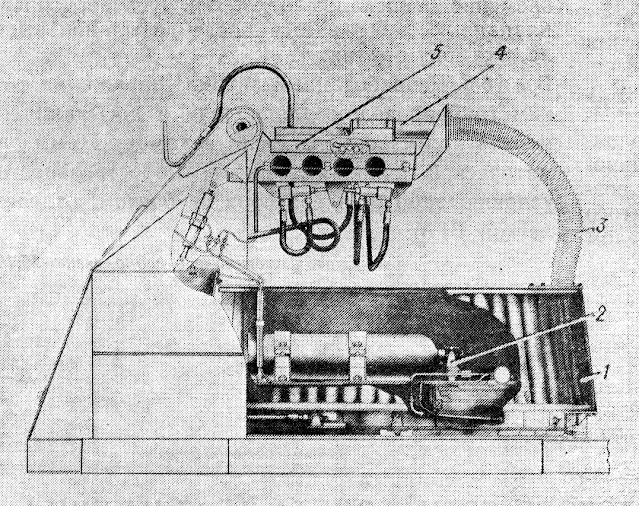
A tank's overall performance during combat does not only depend on the technical characteristics . It also depends on the psychological, emotional and biological factors of the crew and their given tasks.  One way to ease the crew's operating stress is to automate certain processes of the vehicle. But in some cases, this solution does not work, due to the higher qualification requirements for the operation. This issue is more significant when the overall operation complexity of certain modules becomes more delicate and requires highly qualified personnel. As a result, this increases the stress level of crew members. This may be less of an issue with a highly trained crew member but on the other side, the overall performance factor of a crew member heavily depends on the surroundings in which he performs, especially in extreme conditions, such as the crew compartment of any AFV, which can become a harsh operating climate due to the fluctuating microclimate.  A vehicle'...