Posts

Showing posts with the label Story

Unrealised upgrade proposal for 2S3 "Akatsiya" - Vydelka

Image
R&D "Vydelka" was a modernization proposal drafted by "Transmash" (formerly known as OKB-3) for the Russian Ministry of Defence. The modernization focused on improving the firing range along with internal vehicle changes. The modernisation would be done by "Uraltransmash" during major vehicle repairs since the 2S3M and M1 variants were no longer produced. The initial plan to increase the firing range was to integrate newer 2S19 munitions like 3OF45 and 3OF64, but that was impossible due to the rifling count and length of the 2A33, which caused instability. As a solution, the barrel length was increased by 1760mm, which was enough for the aforementioned munitions. The estimated ranges with these changes are as follows: 19,7km for 3OF45, 21,5km for 3OF64 and 25,1km for 3OF61.   The ammunition stowage inside the vehicle did not undergo significant changes and was based on the 1985 layout. For fire-control solutions, it was proposed to install the 1V519, r...

Prototype 2S3M 'Akatsiya' with M-385 155mm gun

Image
The Government Unitary State Enterprise "Factory No.9" had an initial start in producing standardized artillery and tank guns. In 1995, the factory started to develop 155mm gun systems. At the time, Russia already produced varying types of towed 155mm artillery guns.  This development and modernization cycle was initiated after the existing in-service artillery systems utilizing a 152mm calibre gun such as the 2S3M 'Akatsiya' or 2S19 'Msta' were noticeably lacking in performance when compared to Western 155mm gun designs used on the PzH 2000 or G6. A large performance gap formed between Russian and Western 155mm guns. In addition to the growing performance gap, there was a global standard for the usage of larger calibre artillery guns, in which the 155mm gun dominated the market.  As a result, Russia saw the opportunity to create its own 155mm gun design, which would open up the doors to international weapon trade programs.  During the development of 155mm gun...

Modern protective suits for armoured fighting vehicle crews

Image
Splinters are produced by kinetic energy projectiles such as APFSDS after penetrating the main armour and creating spalling fragments that not only disable internal equipment but also disable the crew inside. Occasionally, spalling is also created after a projectile does not penetrate a vehicle armour plate but causes the internal layer of armour to crack and shatter, causing a dense cloud of splinters that can reach weights of up to 500 grams.  Fragmentation is also created after the main armour is penetrated by shaped-charge ammunition (HEAT-FS). This can create a burst of splinters of around 140 to 260 fragments in an 80 °-100 ° cone. Lightly armoured vehicles being hit by smaller calibre ammunition such as 7,62mm/12,7mm undergo the same effect, just at a smaller scale, due to thinner armour plates and generally smaller projectiles.  The probability of the crew being incapacitated by splinters is high due to the density of fragments and the wide dispersion angle. 2 groups o...

BTR-80 made for Spetsnaz

Image
The greatest danger to an APC is the defeat of compartments where the crew sits and the loss of power diverted from the engine. As a result, the vehicle becomes a stationary target and is a 'grave' for the crew inside. Equally, important is the preservation of combat power, providing the APC with the firepower that in return affects its total combat potential. Damage to the undercarriage posed less danger to the vehicle due to its 8 wheel chassis and ability to retain mobility with blown-out wheels.  The 8mm-10mm thick side armour of the BTR-80 could not hold direct hits from RPGs or close-by mine explosions. During the final large combat interactions in Chechnya in May of 1996, The Russian forces lost a large number of vehicles including BTRs that were mainly destroyed by RPGs. This problem was approached with a 'head-on' solution, by attaching additional armour plates, steel screens or spaced armour, as was done by the Estonian Army before the collapse of the Soviet U...

T-90 demonstrator and its uncommon sight

Image
 As previously mentioned in my earlier posts about "AGAVA-2", there was a T-90 variant that did, in fact, mount that sight.  The year is 2000-2002, by that point, Russia made several T-90 variants, including some export variants. Those being: T-90 Obr.1992, T-90K Obr.1994, T-90S Obr.1992, T-90C Variant No.1 Obr.1992, T-90S Obr.1999, T-90SK Obr.1999, T-90S "Bhishma" Obr.2000. The mentioned variants have at some point either been exported to countries in batches, created as proposed export designs or have been sent out for tank trials.  But Russia created another T-90S variant that came with some non-standard equipment. That being a T-90S being shown during a semi-closed demonstration of vehicles back in 2000-2002. The tank featured its standard OEAPS "Shtora-1" but came with an unusual sight that was very rare for early T-90 and T-90S tanks. That being the TO1-PO2RT "AGAVA-2RT" thermal imaging sight. The sight itself had several different upgrade...

Object 490A "Бунтарь" - "Rebel"

Image
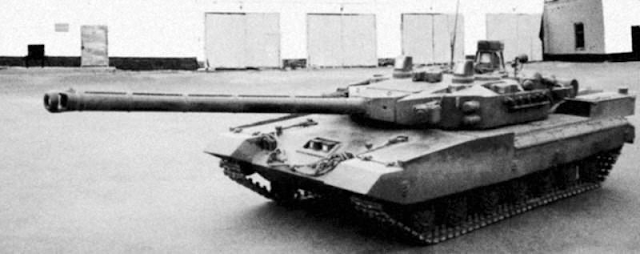
  Work on the new Kharkiv tank has been officially carried out since the early 1980s under the leadership of N.A. Shomin, chief designer of the KMDB (Kharkiv Morozov Machine-Building Design Burau). Initiative work on the new medium tank of the 1980s, NST-80 (New Soviet Tank-80), began even earlier, on 08/17/1977 when a group of designers was formed, approved by N. A. Shomin. Object 490A "Бунтарь" - "Rebel" running mockup The layout of the promising tank was represented by two projects - the double Object 490, developed by E.A. Morozov since the end of the 70s, and the Object 490A with a crew of three people, a low-profile turret and outboard weapons, the development of which was supported by DB (Design Burau), weapons systems department, deputy chief designer of the KMDB Kovalyukh Vadim Romanovich . The layout of Object 490 by E. A. Morozova had a risky and requiring further elaboration solution associated with a crew of two, which increased the requirements for inf...

Object 490 "Тополь" - "Poplar"

Image
      The project of a promising tank developed in the 1980s by E.A. Morozov. Object 490 "Тополь" - "Poplar" mockup                          The design had some primary characteristics which are worth mentioning. A crew consisting of two people - the gunner commander and the driver.  Reducing the crew to two and placing them in a compact, well-protected capsule.  The use of a hydropneumatic suspension.  In addition to solving the main task - increasing average speeds by improving the smoothness characteristic, it makes it possible to control the tank's clearance, which increases the manoeuvrability and survivability in battle.  In addition, the controlled hydropneumatic suspension by changing the trim of the machine allows you to increase the gun pointing angles in the vertical plane. Reducing the crew to two people and placing them in a compact, well-protected capsule with the ...