Posts

Showing posts with the label Cold War

BTR-80 made for Spetsnaz

Image
The greatest danger to an APC is the defeat of compartments where the crew sits and the loss of power diverted from the engine. As a result, the vehicle becomes a stationary target and is a 'grave' for the crew inside. Equally, important is the preservation of combat power, providing the APC with the firepower that in return affects its total combat potential. Damage to the undercarriage posed less danger to the vehicle due to its 8 wheel chassis and ability to retain mobility with blown-out wheels.  The 8mm-10mm thick side armour of the BTR-80 could not hold direct hits from RPGs or close-by mine explosions. During the final large combat interactions in Chechnya in May of 1996, The Russian forces lost a large number of vehicles including BTRs that were mainly destroyed by RPGs. This problem was approached with a 'head-on' solution, by attaching additional armour plates, steel screens or spaced armour, as was done by the Estonian Army before the collapse of the Soviet U...

"AGAVA" - "AGAVA-2" and its confusing history

Image
When covering Soviet sight technology there are always some interesting designs and approaches to solving an issue. It is a common fact that the Soviet Union in the 1980s-1990s was quite behind in thermal sight technology. Only in the 1990s, but to be specific in 1992, the Soviet Union now Russia started to field small batches of thermal sights on their tanks, primarily T-80Us and some of the early T-90 variants, which just recently entered service. Russia's journey through creating its own domestic thermal sight traces back to 1982.  The 1980s were quite an important time for the 'Krasnogorsk Factory named after S.A Zverev', which is still to date an Optical Engineering and Optoelectronics factory. The factory is primarily known for making domestic Soviet cameras back in the day. However, that's not the only thing that the factory has produced back then.  Close to the mid-1980s, the facility was contracted to develop new thermal sight technology for the Soviet Ministry...

Object 490A "Бунтарь" - "Rebel"

Image
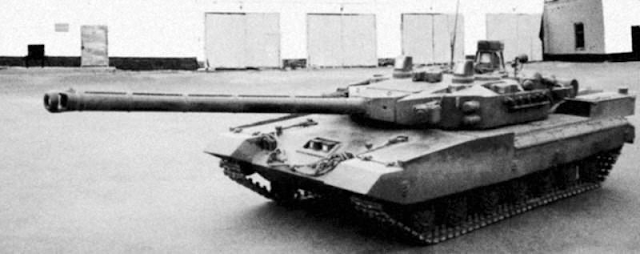
  Work on the new Kharkiv tank has been officially carried out since the early 1980s under the leadership of N.A. Shomin, chief designer of the KMDB (Kharkiv Morozov Machine-Building Design Burau). Initiative work on the new medium tank of the 1980s, NST-80 (New Soviet Tank-80), began even earlier, on 08/17/1977 when a group of designers was formed, approved by N. A. Shomin. Object 490A "Бунтарь" - "Rebel" running mockup The layout of the promising tank was represented by two projects - the double Object 490, developed by E.A. Morozov since the end of the 70s, and the Object 490A with a crew of three people, a low-profile turret and outboard weapons, the development of which was supported by DB (Design Burau), weapons systems department, deputy chief designer of the KMDB Kovalyukh Vadim Romanovich . The layout of Object 490 by E. A. Morozova had a risky and requiring further elaboration solution associated with a crew of two, which increased the requirements for inf...

Object 490 "Тополь" - "Poplar"

Image
      The project of a promising tank developed in the 1980s by E.A. Morozov. Object 490 "Тополь" - "Poplar" mockup                          The design had some primary characteristics which are worth mentioning. A crew consisting of two people - the gunner commander and the driver.  Reducing the crew to two and placing them in a compact, well-protected capsule.  The use of a hydropneumatic suspension.  In addition to solving the main task - increasing average speeds by improving the smoothness characteristic, it makes it possible to control the tank's clearance, which increases the manoeuvrability and survivability in battle.  In addition, the controlled hydropneumatic suspension by changing the trim of the machine allows you to increase the gun pointing angles in the vertical plane. Reducing the crew to two people and placing them in a compact, well-protected capsule with the ...

Corundum armor inserts - Ultra Porcelain

Image
  In 1975, the T-64A turret with corundum filler developed by VNIITM was adopted.  The technology of casting turrets with ceramic filler was developed as a result of joint work of VNII-100, Kharkiv plant No. 75, and South Ural radio-ceramics plant. The armour of the turret consisted of; 115mm cast armour steel > 140 mm ultra-porcelain balls > rear wall 135 mm steel with an inclination angle of 30 degrees. View of a Corundum ball ( Ultra porcelain ) ВНИИТМ ( Всероссийский научно-исследовательский институт транспортного машиностроения )  VNIITM --  All-Russian Research Institute of Transport Engineering (Mobile Vehicle Engineering Institute) An array of Corundum ball inserts Subsequently, the armour protection of Kharkiv tanks was improved, including in the direction of using more advanced barrier materials, at the end of the 1970s and onwards T-64Bs used  the BTK-1Sh type steel , made by Electro-Slag remelting. From this armour composition change , the resi...

2S14 Zhalo-S

Image
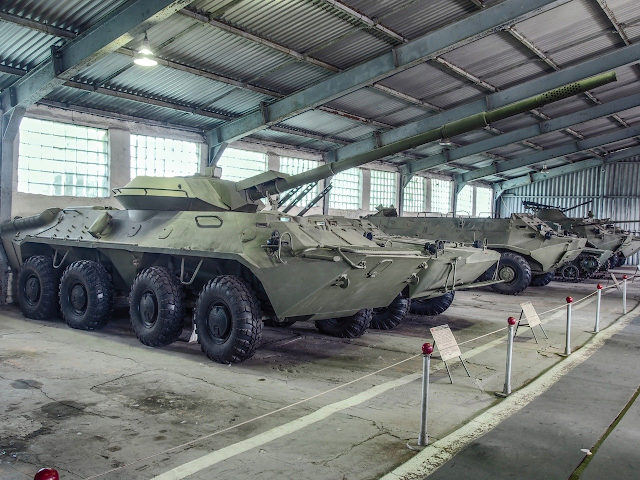
2S14 Zhalo-S prototype tank destroyer   2S14 Zhalo-S (Kubinka Tank Museum) The 2S14 Zhalo-S was a prototype tank destroyer, made in the mid-’70s. The Zhalo-S was using the BTR-70 chassis. Instead of a high caliber heavy machine gun, it was armed with an 85-mm 2A62 gun with an inbuilt automatic autoloader. The tank weighed 12tons and was powered by 2 engines( ZMZ-4905 ) totaling 240hp. The vehicle was able to reach a speed of 80km/h on the road and 10 km/h in the water. As previously mentioned, the chassis was the same as the BTR-70 featuring 9mm or armor on the front and 7mm on the side and rear. The 2A62 gun (a modified version of the D-44) was shooting up to 15 rounds per minute(4 second reload), but the penetration was considered too poor for modern warfare, due to the most powerful shells not having an adequate performance compared to other vehicles made during that time.  Schematic of 2S14 Shalo-S The Russian marine corp in the mid-70s was armed with the out-dated PT-76, ...